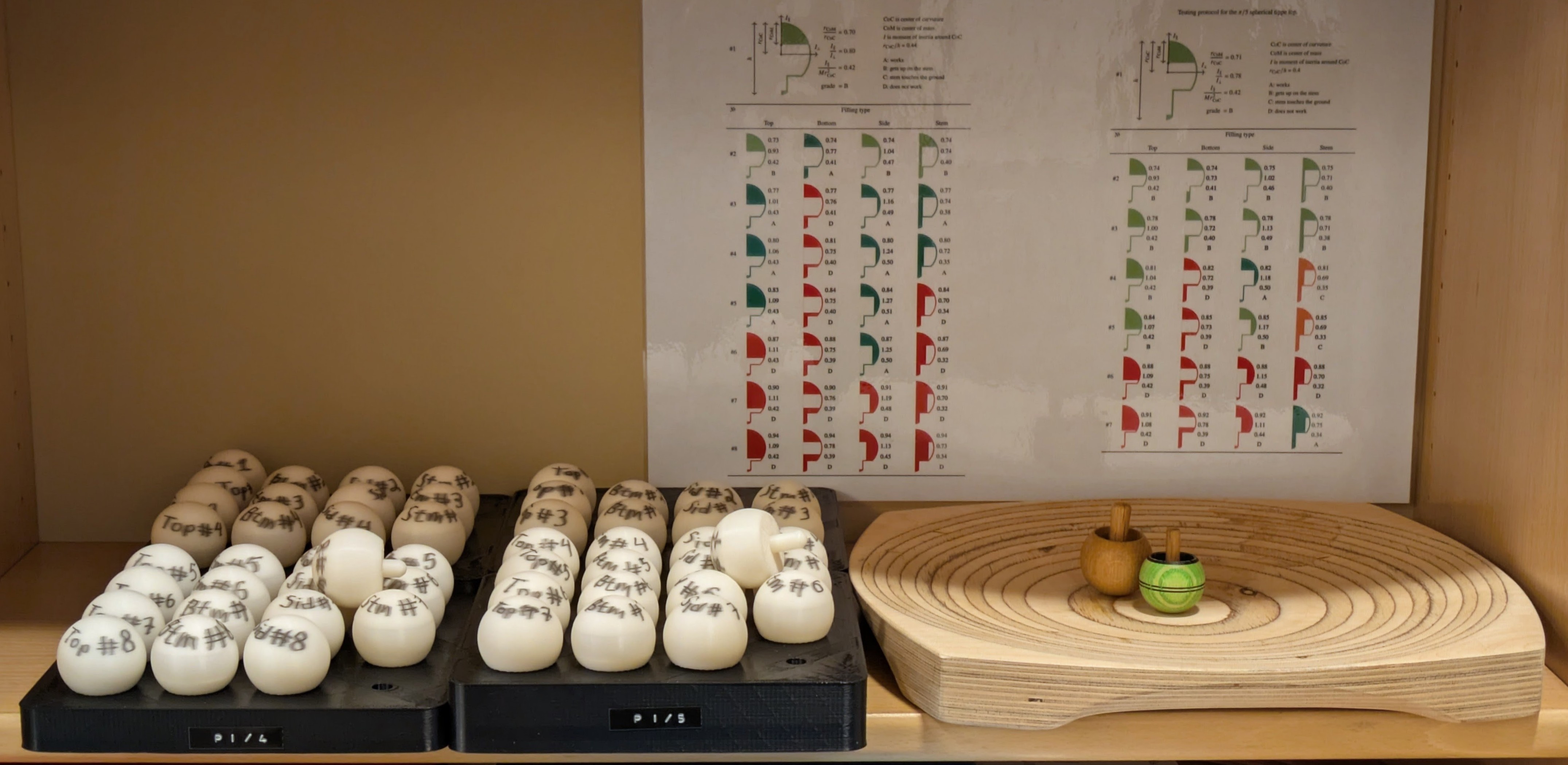
I am interested in designing a custom 3D-printable tippe top — a spinning toy that flips upside down while rotating due to its shape and mass distribution. I soon realized, however, that creating a functional one is a nontrivial task. To support my development process, I 3D-printed several tippe tops with varying characteristics to identify which traits are essential for proper flipping. Although I was unable to pinpoint the design features that guarantee flipping, the results of my experiments may still be of interest to others.
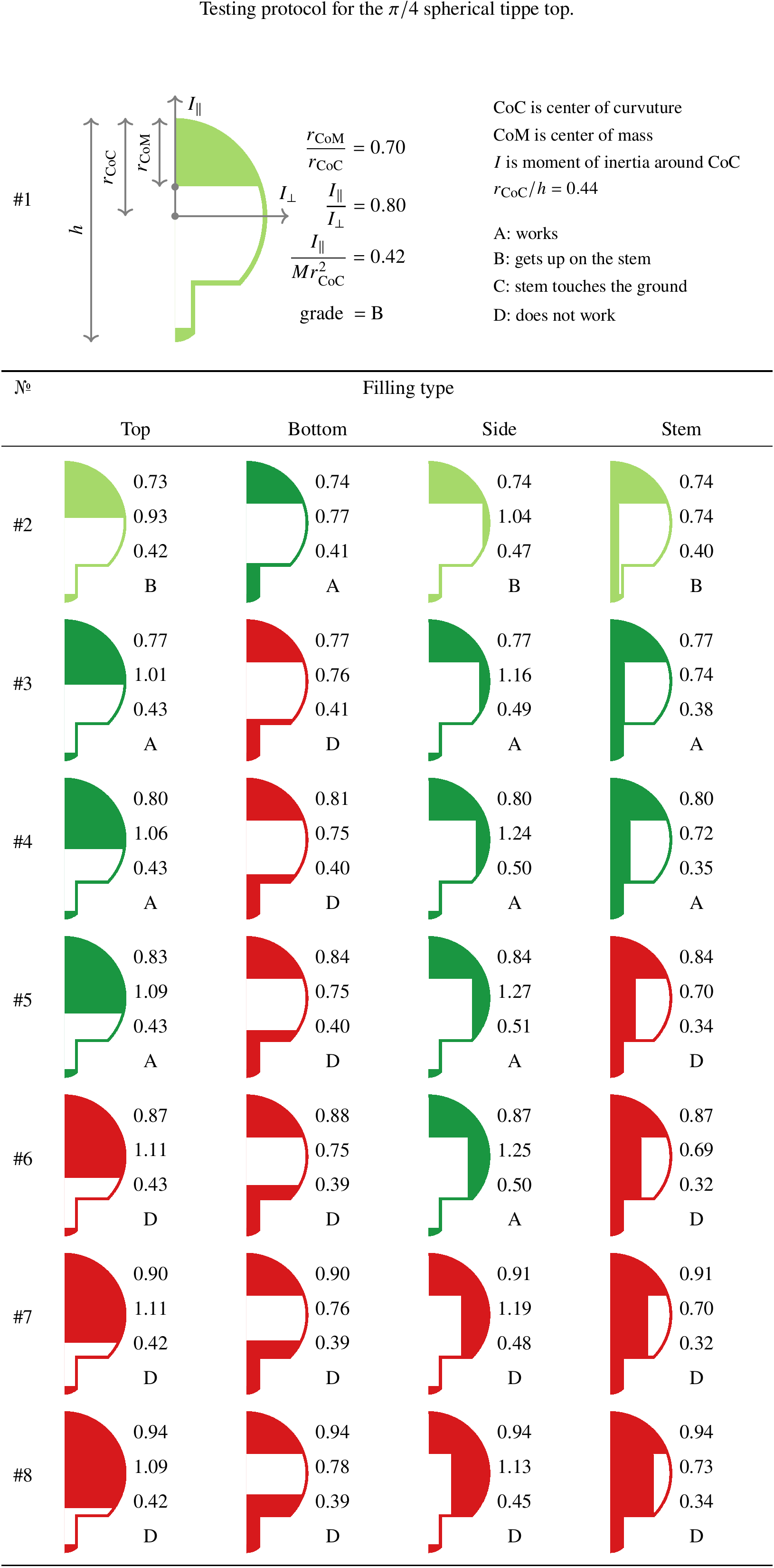
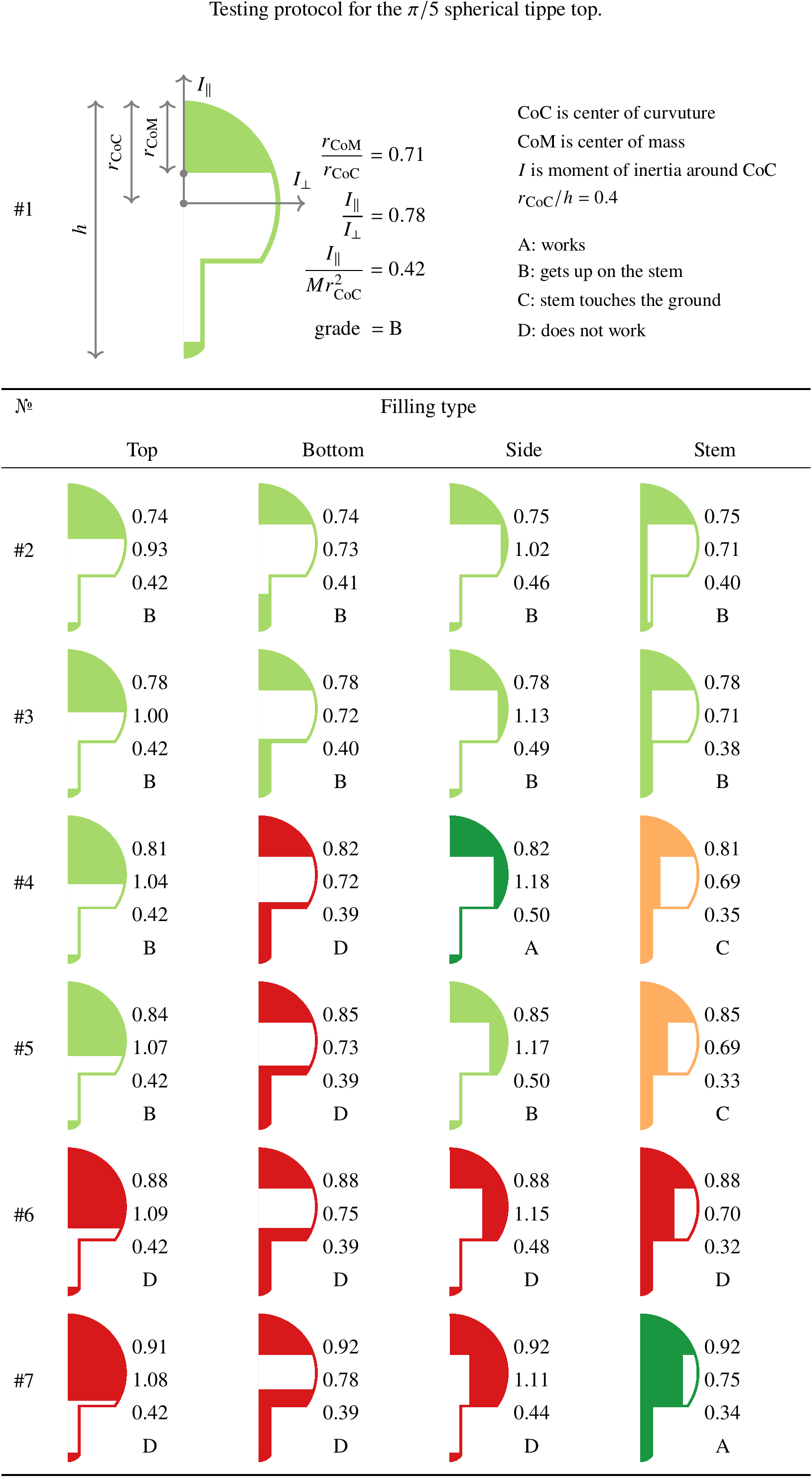
All the tippe tops I tested are spherical, with the sphere radius (see the cross-section figures below). The tippe tops are divided into two main groups, named for historic reasons π/4 and π/5, with a shorter and longer stems respectively. Within each group, I started with a basic design that minimizes the height of the center of mass at rest , since it is well established that a tippe top filps only when . The resulting basic design contains a large internal void that can be filled with mass in an arbitrary manner.
With the basic design in place, I proceeded to test four methods of filling the internal void: from the top, from the bottom, from the side, and from the stem of the tippe top (see the cross-section figures below). For each filling method, several fill levels were tested, each yielding similar values of across the different filling types.
To 3D-print the studied tippe tops yourself, download the corresponding STL files, stl_1÷4_π.7z and stl_1÷5_π.7z. Additionally, to facilitate the analysis, the corresponding cross sections are provided as HDF5 files HDF5_data.7z.
All the printed tippe tops were spun by my friend, Enrique, and graded A to D by their performance.
The only reliable advice I can offer when designing a tippe top is to first minimize the height of the center of mass at rest, then gradually add mass to the outer radius (side filling) until the tippe top performs the best.